
MIR Enterprise
Organization-level participation infrastructure for internal systems. Establish continuity without exposing activity details.
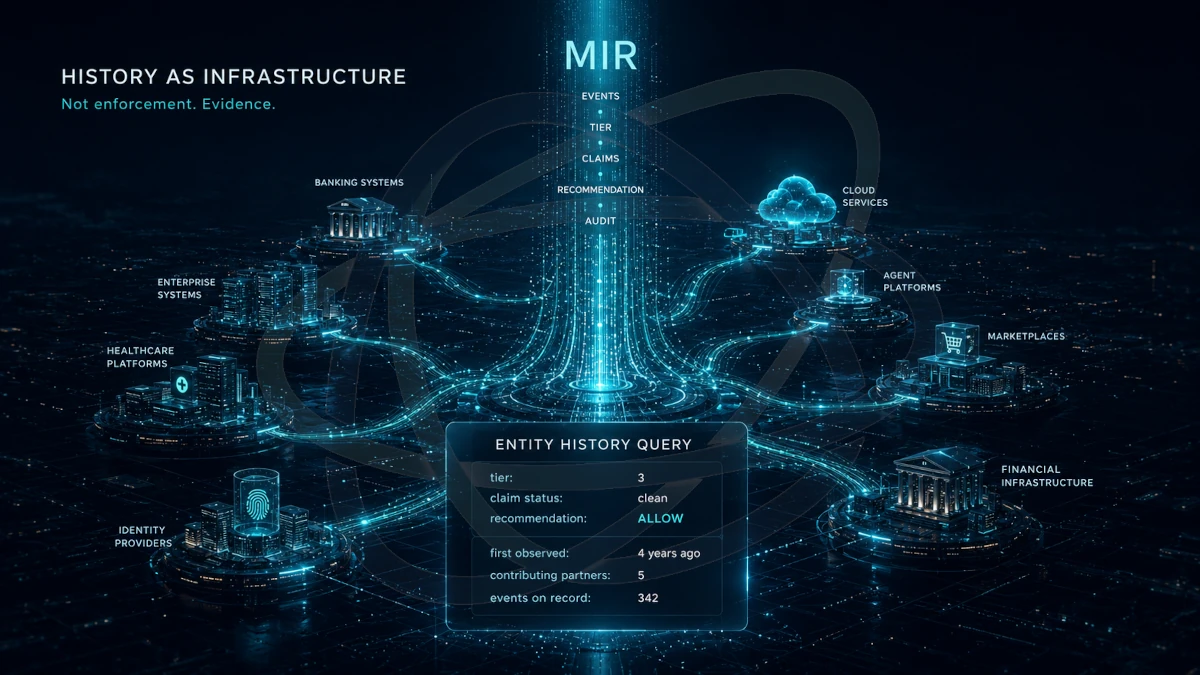
What is participation history? The verifiable record of what an entity (employee, contractor, AI agent, service account) has actually done over time -- transactions, sign-ins, approvals, agent actions -- expressed as structured events. MIR stores this record and surfaces it as a signal when high-stakes decisions are made.
New to the vocabulary? See the glossary for every term used on this page.
What MIR Enterprise Is
MIR operates at the organizational level. Enterprises require members to participate in MIR in order to access protected internal systems.
Participation establishes continuity across internal tools without exposing activity details. MIR answers one question: does this user have history on record?
What It Enables
Gate high-risk actions based on participation history. New team members aren't blocked from working -- they're guided through additional checks until they've built sufficient history.
SSO proves identity. MIR adds continuity. Together they enable graduated trust for sensitive operations.
How It Works
The problem: SSO tells you who someone is. It doesn't tell you what they've done. A compromised credential passes SSO. A freshly provisioned account gets the same access as a 5-year veteran.
What MIR does: Partners across the ecosystem submit structured events when users complete meaningful actions. MIR aggregates these into tier-level continuity signals -- not behavioral data, not scores, not PII. Just: does this identity have history on record, how deep, how diverse.
Policy engine: Call MIR's policy API at the point of access. It returns a recommendation -- ALLOW, STEP_UP, LIMIT, or DENY -- based on rules you define. Your system decides what to do with it. Tier thresholds, minimum partner diversity, event density, account age. You set the policy. MIR evaluates it; your system enforces the recommendation.
What it doesn't do: No behavioral monitoring. No activity details. No raw events cross the boundary. Tier-level indicators only. Not an identity provider, not a fraud score, not a surveillance tool.
Integration: REST API, scoped agent-level permissions, SSO-compatible (WorkOS), deploys alongside existing IAM stack.
Where MIR Sits in the Stack
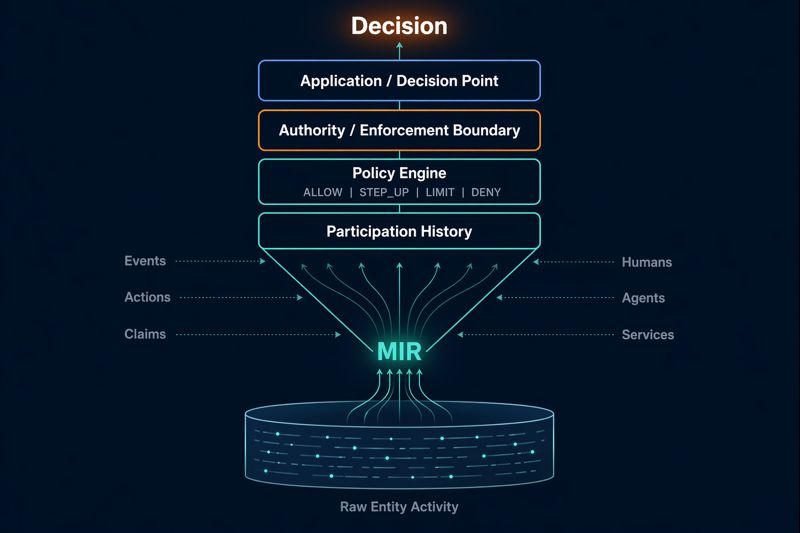
Participation Model
MIR Enterprise is organization-wide and non-optional for protected resources. This is infrastructure, not a feature toggle.
- Organization-wide enforcement via SSO, gateway, or internal applications
- Members link at least one external account to establish history
- MIR queried at access time with a simple yes/no continuity response
Security & Governance
MIR does not monitor behavior. It does not score users. It provides a single signal: participation history exists, or it doesn't.
Activity details stay with the platforms where they occurred. Your organization receives only tier-level indicators -- never raw events, transactions, or behavioral data.
Custody of the Record
Most organizations already log what their systems do. An examination asks a narrower question: can you produce that record without the cooperation of the party whose conduct is in question?
Central collection solved the server boundary decades ago. It does not solve the custody one. When the collector is run by the same organization under scrutiny, the record can still be altered, deleted, or withheld by that organization. The record left the server and never left the party.
- Held apart from both the acting entity and the operator of the system it acted in
- Exported as a signed, offline-verifiable bundle carrying an inclusion proof for every event
- Checked by a verifier that imports node:crypto and node:fs and nothing else, so it cannot reach the network or reach us
- Sealed into checkpoints anchored to Bitcoin and observed by two independent witnesses
A verification pass proves the record was not altered. It does not prove the record is complete, and no amount of cryptography will. MIR declares its coverage rather than claiming completeness.
"Better decisions don't come from more data at runtime, but from knowing who you're dealing with before execution begins — that's where MIR adds leverage."
"MIR shifts governance from reacting to behavior to reasoning about identity and history before action is even possible."
Who Should Use MIR Enterprise
Organizations that control access to internal systems and want to add a continuity layer beyond authentication.
Not intended for:
Optional plug-ins, per-user participation displays, behavioral monitoring systems, or consumer-facing trust badges.
Ready to explore?
Existing customers can log in. New organizations can request access or submit an inquiry.